Friday, 4 May 2012

Hanami (花見) - 'Flower Viewing'


Hanami-zake (like Tsukimi-zake) is an optional hand in Koi-Koi, which is fairly easy to obtain and scores an easy 5 points.


Hanami is the Japanese traditional custom of enjoying the beauty of flowers, 'flower' in this case almost always meaning Cherry blossoms (Sakura) or (less often) Plum blossoms (Ume).

From the end of March to early May, Sakura bloom all over Japan and around the first of February on the island of Okinawa. The blossom forecast (桜前線 Sakura-zensen, literally Cherry blossom front) is announced each year by the weather bureau and is watched carefully by those planning Hanami as the blossoms only last a week or two.


In modern-day Japan, Hanami mostly consists of having an outdoor party beneath the Sakura during daytime or at night. In some contexts the Sino-Japanese term kan'ō (観桜, view-Cherry) is used instead, particularly for festivals. Hanami at night is called yozakura (夜桜, literally night Sakura).
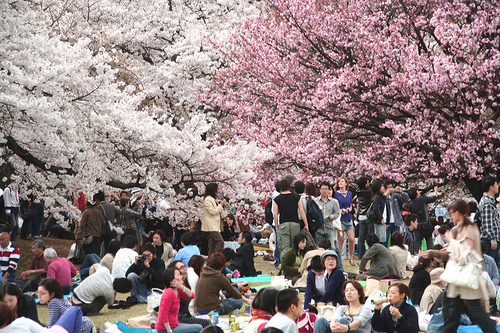


In many places such as Ueno Park, Tokyo temporary paper lanterns are hung for the purpose of yozakura. On the island of Okinawa, decorative electric lanterns are hung in the trees for evening enjoyment, such as on the trees ascending Mt. Yae, near Motobu Town or at Nakijin Castle.

A more ancient form of Hanami also exists in Japan, which is enjoying the Plum blossoms (梅 Ume) instead, which is narrowly referred to as Umemi (梅見, Plum-viewing). This kind of Hanami is popular among older people because they are more calm than the sakura parties, which usually involve younger people and can sometimes be very crowded and noisy.

The practice of Hanami is many centuries old. The custom is said to have started during the Nara Period (710–794) when it was Ume blossoms that people admired in the beginning. But by the Heian Period (794–1185), Sakura came to attract more attention and Hanami was synonymous with Sakura. From then on in tanka and haiku, 'flowers' meant Sakura.

Hanami was first used as a term analogous to Cherry blossom viewing in the Heian era novel 'Tale of Genji'. Although a Wisteria viewing party was also described, the terms 'Hanami' and 'Flower party' were subsequently used only in refernce to Cherry blossom viewing.

'Hana no En' - from the 'Tale of Genji'

Sakura originally was used to divine that year's harvest as well as announce the rice-planting season. People believed in kami inside the trees and made offerings. Afterwards they partook of the offering with sake.

Emperor Saga of the Heian Period adopted this practice and held Flower-viewing parties with sake and feasts underneath the blossoming boughs of Sakura trees in the Imperial Court in Kyoto. Poems would be written praising the delicate flowers, which were seen as a metaphor for life itself, luminous and beautiful yet fleeting and ephemeral. This was said to be the origin of Hanami in Japan.

The custom was originally limited to the elite of the Imperial Court but soon spread to Samurai society and by the Edo period, to the common people as well. Tokugawa Yoshimune planted areas of Cherry blossom trees to encourage this. Under the Sakura trees, people had lunch and drank sake in cheerful feasts.


Hanami parties in the grounds of Himeji Castle
 
 
Today, the Japanese people continue the tradition of Hanami, gathering in great numbers wherever the flowering trees are found. Thousands of people fill the parks to hold feasts under the flowering trees and sometimes these parties go on until late at night. In more than half of Japan, the Cherry blossoming period coincides with the beginning of the school and fiscal years and so welcoming parties are often opened with Hanami. The Japanese people continue the tradition of Hanami by taking part in the processional walks through the parks. This is a form of retreat for contemplating and renewing their spirits.


Tsukimi (月見) - 'Moon Viewing'


Tsukimi-zake is one of the optional hands in Koi-Koi.  I say optional as some don't play it as it is a fairly easy hand (like Hanami-zake) to get and is worth an easy 5 points.


Tsukimi refers to the Japanese tradition of holding parties to view the harvest moon. The custom is thought to have originated with Japanese aristocrats during the Heian period, who would gather to recite poetry under the full moon of the eighth month of the lunisolar calendar, known as the 'Mid-Autumn Moon'. Since ancient times, Japanese people have described the eighth lunisolar month (corresponding to September on the contemporary Gregorian calendar) as the best time for looking at the moon, since the relative positions of the earth, sun, and moon cause the moon to appear especially bright.  


On the evening of the full moon, it is traditional to gather in a place where the moon can be seen clearly, decorate the scene with Japanese pampas grass and to serve white rice dumplings (known as Tsukimi dango), taro, edamame, chestnuts and other seasonal foods, plus sake as offerings to the moon in order to pray for an abundant harvest. These dishes are known collectively as Tsukimi dishes (月見料理 tsukimi ryōri). Due to the ubiquity of sweet potato or taro among these dishes, the tradition is known as Imomeigetsu (芋名) or 'Potato harvest moon' in some parts of Japan.


From 862 until 1683, the Japanese calendar was arranged so that the full moon fell on the 13th day of each month. In 1684, however, the calendar was altered so that the new moon fell on the first day of each month, moving the full moon two days later, to the 15th day of the month. While some people in Edo (present-day Tokyo) shifted their Tsukimi activities to the 15th day of the month, others continued to observe the festival on the 13th day. Furthermore, there were various regional observances in some parts of Japan on the 17th day of the month, as well as Buddhist observances on the 23rd or the 26th day, all of which were used as pretexts for often late-night parties during the autumn throughout the Edo period. This custom was brought to a swift end during the Meiji period.

Festivals dedicated to the moon have a long history in Japan. During the Heian period elements of the Chinese Mid-Autumn Festival were introduced to Japan. Members of the aristocratic class would hold moon-viewing events aboard boats in order to view the moon's reflection on the surface of the water. The writing of tanka poetry was also an element of such mid-autumn moon viewing festivities.


There are specific terms in Japanese to refer to occasions when the moon is not visible on the traditional mid-autumn evening, including Mugetsu (無月 literally: no-moon) and Ugetsu (雨月 rain-moon). Even when the moon is not visible, Tsukimi parties are held.

There is a story related to this festival - the story of the Jade Rabbit.  This Buddhist story tells that on a day of Uposatha (day of observance), an old man asked for food from a Monkey, an Otter, a Jackal and a Rabbit. The Monkey collected fruits and offered them to the old man, the Otter brought him a fish and the Jackal a Lizard. The Rabbit didn’t have anything to bring, because the herbs constituting his food weren’t good for humans.

The rabbit decided to offer his own body and jumped into  a fire but surprisingly his body did not burn because the old man was Sakra (King of Heaven). For people to remember the rabbit’s sacrifice, the old man drew the rabbit’s image over the moon.


In China it is believed that the Jade Rabbit is boiling an elixir, while in Japan and Korea it is believed that the Rabbit makes mochi (sweet rice).  In Japanese, the process of making mochi is called mochitsuki (餅つき), word that sounds similar to the word for 'full moon', mochizuki (望月).


Hō-ō (鳳凰) - Chinese Phoenix


In Japan, the mythical Phoenix was adopted as a symbol of the Imperial household and in particular, the Empress. This mythical bird represents fire, the sun, justice, obedience, fidelity and the southern constellations.


According to Chinese legend, the Hō-ō appears very rarely and only to mark the beginning of a new era (like the birth of a virtuous ruler, for example). In other traditions, the Hō-ō appears only in peaceful and prosperous times (nesting, it is said, in Paulownia trees) and hides itself when there is trouble. As the herald of a new age, the Hō-ō decends from heaven to earth to do good deeds and then it returns to its celestial abode to await a new era.

It is both a symbol of peace (when the bird appears) and a symbol of disharmony (when the bird disappears). In China, early artefacts show the Phoenix (female) as intimately associated with the Dragon (male) and the two are portrayed either as mortal enemies or as blissful lovers. When shown together, the two symbolise both conflict and wedded bliss and are a common design motif in many parts of Asia.

The mythical Chinese bird is thought to have been introduced into Japan in the Asuka period (mid 6th to mid 7th century AD). The Phoenix has a bird's beak, a Swallow's jaw, and a Snake's neck; the front half of its body is thought to resemble a Giraffe, the back half a Deer. Its back resembles a Tortoise and its tail is like a Fish.


It is often shown in a Paulownia tree (Chinese Parasol tree), with bamboo in the background, or surrounded by Chinese Arabesque foliage. It became a popular decorative motif in the Nara period and was used on a wide variety of items including textiles, mirrors, chests and lacquerware.

 
Paulownia

 
Outstanding early examples of Phoenix designs can be seen on the ceiling of Hōryūji Kondō Nishi-no-ma (法隆寺金堂西の間) (late 7th century). Hō-ō depicted on the back of mirrors were popular in the Heian period (9th-12th century). Some of these used a Chinese style but others Japanized the Hō-ō motif, replacing Arabesque foliage with Japanese wild grasses and changing the bird to resemble a blue Magpie or a Crane.


A famous pair of Hō-ō statues, made of copper and measuring one metre in height, can be seen on the roof of Byōdō-in Hō-ō-do (平等院鳳凰堂), Kyoto (10th century).


Throughout the 13th to 19th centuries, the Hō-ō remained a popular design, particularly on gold and silver lacquered boxes and for Noh (theatre) costumes. The original Chinese background of Paulownia and bamboo was gradually replaced by combinations of Peonies, Cherry blossoms, Crysanthemums and other seasonal Japanese wild flowers.


Kanreki Focus Training for iPad

'Kanreki Focus Training is ninja training for your brain! It features amazing bamboo flute music and stunning artwork. See how fast you can clear the concentration grids and collect the hanafuda card art. See the art gallery on the statistics page. Unlock all the seasons by perfectly completing the previous level. Complete all four seasons and try for the GAJI level. Compete against the world on OpenFeint, show them you are the ultimate mind-ninja! (Sign up for OpenFeint to access achievements and leaderboards).

Great game for the kids with the addition of KIDS MODE! Children of all ages can practice their counting ability in Kanreki Focus Training. Keeps them quite busy in the car on road trips, while providing them practice with their numbers'!


http://itunes.apple.com/us/app/kanreki-focus-training/id420847298?mt=8

Thursday, 3 May 2012

Yoshino and Sakura no Tan


'Sakura no Tan'
 
On the Tanzaku (Scroll) above is the word 'Miyoshino'.  'Mi’ is a term of respect and ‘Yoshino’ is the place name. The Emperor of Japan had a villa there. Thus, ancient Japanese people called the place ‘Miyoshino’ out of respect for their Emperor.

Yoshino is located in the northern portion of Yoshino District in Nara prefecture and the majority of the town is covered by mountains.  It has an estimated population of 9,397.


For adherents of Shugendo, Yoshino is the traditional beginning of the Mount Omine pilgrimage trail; however, many hikers begin and end their trek from the Dorogawa district of Tenkawa Village.

Mount Yoshino is famous for its 30,000 Sakura (Cherry) trees. These flowering specimen trees were planted in four groves at different altitudes, in part so that the famed trees would come into bloom at different times of the spring.


An account in 1714 explained that, on their climb to the top, travellers would be able to enjoy the lower 1,000 cherry trees at the base, the middle 1,000 on the way, the upper 1,000 toward the top, and the 1,000 in the precincts of the inner shrine at the top.


'Rainy Season'


This would make an excellent 'Rain-man' errrrr I mean 'Rain-woman' card!  Check out the orange frog on her right hand.


http://blogs.dion.ne.jp/monoren/

A Case of Mistaken Identity?

Lets take a closer look at the bird in the Ume (Plum) suit.


Ume Ni Uguisu

Many Japanese people mistake Japanese White-Eye (目白 Mejiro) for Japanese Bush Warbler (鶯 Uguisu). There has been a confusion between the two birds among the Japanese people and there are a couple of reasons for that. For one thing, 梅に鶯, Ume blossom and Japanese Bush Warbler, is one of certain traditional pairings of flowers and birds/animals like 松に鶴/Pine and Crane (an auspicious pair), 藤に不如帰/Wisteria and Cuckoo, 紅葉に鹿/Maple and Deer and so on.


Japanese White-Eye in a Plum tree

The olive-green birds which come for the nectar of Ume blossoms are Japanese White-Eyes, while Japanese Bush Warblers come to Ume trees for insects when they are thick with foliage.  Japanese White-Eyes are not so cautious that are spotted out rather easily.


Japanese Bush Warbler

Japanese Bush Warblers are drab olive green. They are cautious and usually remain deep in the shadow of foliage in the grove.

Ume blossoms are thought to be a harbinger of spring as they bloom much earlier than other spring plants when air is still cold. The cry of the male Japanese Bush Warbler also heralds the arrival of spring with their distinctive chirps, Ho-Hokekyo, which is a pan to 法-法華経, the Lotus Sutra of Buddhism. People hear the chirping of a Japanese Bush Warbler from nowhere and see the appearance of Japanese White-Eye among Ume blossoms, which caused misunderstanding and confusion about the two birds.

Bush Warblers and Ume blossoms have been featured in haiku as seasonal words of spring and often the motif of paintings and other arts.


Source: stardustenglishwriting.blogspot.com

Wednesday, 2 May 2012

Hana-Awase (花合わせ) Rules

Here are the rules for Hana-Awase as supplied with my Disney Hanafuda.

*(sic), (the) and (of rules supplied with deck) are my additions to the text.


Hana-Awase (花合わせ)


Number of players: mostly 3 or 4.
The object is to capture scoring cards with cards in your hand and in the field.  Each card has its score.  Player with the highest score is the winner.

Dealing

Each player takes one card from a stock of HANAFUDA in (sic) face down.  The player with the earliest month (smallest figure) becomes the dealer for the first round (in the case of a tie, the card with the highest core wins).

Procedure

1) In a 3 player game, the dealer deals 7 cards (face down) to each player and 6 cards (face up) to the field.  They are called 'Cards in Hand' and 'Cards in the Field' respectively.  The remaining cards are put in the middle of the field in (sic) face down.  The cards are called 'Stock'.
* In a 4 player game, 'Cards in Hand' and 'Cards in the field' shall be 5 and 8 each.

2) If one of 'Cards in Hand' matches a card in the field in month, (the) dealer places the card (face up) from 'Cards in Hand' on top of the matched card and capture (sic) both cards.  Then (the) dealer takes the top card from the 'Stock'.

3) If the card matches a card in the field in month, (the) dealer places the card (face up) on top of the matched and captures both cards.
* If there are two same month cards in the field, dealer chooses which card to capture (usually higher score card).

4) If no card in 'Cards in Hand' matches any card in the field, dealer puts any one card from 'Cards in Hand' in the field.  Then (the) dealer takes (the) top card from 'Stock' in (sic) face up.
If the card matches, dealer captures both cards.
If no matched card, dealer just puts the top card (face up) in the field.

5) Next player follows the same procedure.  Once all cards in 'Stock' have been captured, the game ends.

6) Player scores all the captured cards.  The score for the individual cards are shown in the table on the reverse side (of rules supplied with deck).  If there are certain set of cards ('Captured Hands' shown on the reverse side), an extra bonus will be given.

---

Card values and scoring

Kasu (Junk) cards = 1pt each
Tanzaku (Scroll) cards = 5pts each
Tane (Animal/Earth) cards = 10pts each
Brights = 20pts each

Captured Hands

Aka-Tan = 35pts
Ao-Tan = 35pts
Nana-Tan = 50pts (7 poems) This hand is made up of 7 scrolls excluding the November scroll card.

Ino-Shika-Cho = 35pts

Goko = 75pts
Shiko = 50pts
Matsu-Kiri-Bozu = 35pts (This hand is made up of the 3 brights of the January, December and August suits).

Tsukimi de Ippai (Tsukimi-zake) = 20pts 
Hanami de Ippai (Hanami-zake) = 30pts


Disney Hanafuda produced by Angel Playing Cards, Kyoto.
http://angelplayingcards.com/index_en.php

Platinum Box XI Hanafuda


You can see more about this cute looking deck by clicking on the link below.  It comes with a set of rules for Hana-Awase.


Japanese scene hanafuda by Yuki-Myst


plum, moon and cherry


http://sakuo3903.blogspot.co.uk/2007_07_01_archive.html

Censored Nekomu Hanafuda


http://nekobooru.net/post/show/18031

Fuyuki Maehara 'ikkoku' 2012


Hyakki no Hanafuda


http://zomokrex.blogspot.co.uk/2011/07/hyakki-no-hanafuda.html

Tuesday, 1 May 2012

Ono no Michikaze - the 'Rain-man'

Here we take a closer look at the 'Rain-man' depicted on the 'Bright' card of the November suit.


Ono no Michikaze or Ono no Tōfū (小野 道風, 894 – 9 February 966) was a prominent Shodōka (Japanese calligrapher) who lived in the Heian period (794–1185). One of the so-called Sanseki 三跡 (Three Brush Traces) along with Fujiwara no Sukemasa and Fujiwara no Yukinari. Tōfū is considered the founder of Japanese style calligraphy or wayōshodō 和様書道.

Michikaze was born in Kasugai, present day Aichi prefecture as the grandson of a courtier-poet, Ono no Takamura. He was a government official, a poet and a calligrapher. He provided highly distinguished calligraphic services for three emperors during his career: Daigo (reigned from 897 to 930), Suzaku (reigned from 930 to 946) and Murakami (reigned from 946 to 967). Michikaze's fame permitted him to serve, at the age of twenty-seven in the Seiryoden, the residential quarters of the imperial court.

As a recognition of his high skill, Emperor Daigo offered the Buddhist monk Kanken two volumes of Michikaze's works in 927 and urged him to take them with him on a voyage to China and commend Michikaze’s calligraphic achievements to the Chinese.  Michikaze had lost much of his sight by the time he died.

Michikaze took the first step in Japanizing the art of calligraphy, imported from China around the 5th century. His works were slightly influenced by the style of the legendary 4th-century Chinese calligrapher Wang Xizhi, however, he added his own refinements that resulted in a softer feel with more freedom of movement than was common under the strictures of Chinese calligraphy.  He created the Japanese style calligraphy (wayo) that was later refined by other two masters, Fujiwara no Sukemasa and Fujiwara no Yukinari. Wayo was accredited and practiced as a pure Japanese art form until the mid-19th century.

Michikaze showed great diligence in his works, which resulted in grandiose character forms and powerful lines. None of Michikaze's kana calligraphy are extant. A number of extant kanji works are believed to be by Michikaze but only a few are positively attributed. One of the well-known works ascribed without much evidence to Michikaze is a draft for an inscription on a byoubu (Japanese folding screen) now mounted as a handscroll in the Tokyo Imperial Household collection. It was executed in semi-cursive script (gyosho) and consisted of ten poems by Michikaze's contemporary Oe no Asatsuna.
 
The collection also has his other masterpieces, like the Gyokusen-Jo handscroll, which are poems by a Tang poet. Michikaze also was attributed to many kohitsu-gire (famous calligraphic works) of the Heian era, among which a scroll containing forty-nine waka poems from the twelfth volume - 'Poems of Love' - of the early-Heian poetry anthology, Kokin Wakashū. Among his last works are eleven letters, in one of which he bemoans the evanescence of life.


On the 20 October 2000 (Heisei 12), an ¥80 'Willow and frog' stamp was issued in Aichi Prefecture, depicting Michikaze watching a leaping frog.

There is a shrine to his spirit in Kyoto, where his divine soul is considered to be protecting the women of the region in maternity.


Source: Wikipedia


hanafuda ex2 by Yoin

Paulownia and Japanese Sword


http://browse.deviantart.com/?q=hanafuda&order=9&offset=192#/d4dwvho

A Game of Hanafuda by rosieru-chan


hwatu by mazery


Queen of Hanafuda by ApricotPlum